


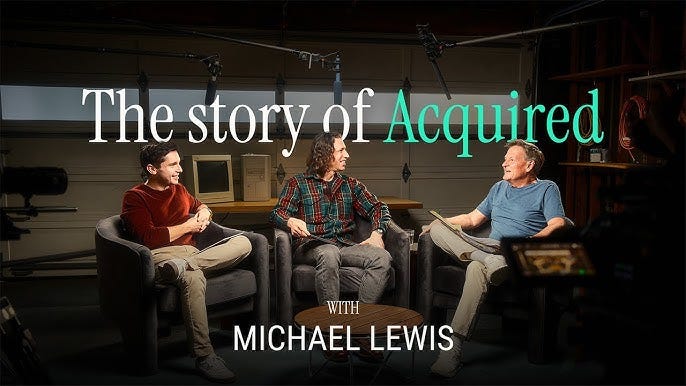
Acquired, hosted by former venture capitalists Ben Gilbert and David Rosenthal, is one of the most popular podcasts in the business niche. Leveraging their natural chemistry and expertise, Ben and David publish exhaustive deep dives, weaving the history of an enterprise from its inception to the present day.
The episodes routinely exceed four hours and occasionally span multiple parts. Alongside David Senra’s Founders, Acquired has become a global benchmark for business media. In the last eighteen months alone, they have interviewed Daniel Ek, Jensen Huang, and Mark Zuckerberg, and hosted Jamie Dimon for a live event at Radio City Music Hall.
This preamble is necessary to establish the show’s immense popularity and its staggering reach across business and technology.
Though I am not a routine listener, I tuned in when I saw the famed author Michael Lewis was interviewing Ben and David for the show’s tenth anniversary. Through Lewis’s skills, I gleaned fascinating insights into the creative process of building a brand and product.
What initially blew me away was the amount of iteration the show endured before it achieved the level of notoriety required to interview the creator of Facebook in a live arena. The hosts knew they wanted to explore their love of business, but the exact execution took several forms.
When the show first gained moderate traction, they maintained a higher cadence of shorter, shallower episodes. While the metrics were appealing, the hosts were savvy enough to realize this was drifting away from their core mission. The increased cadence left less time for research, and the quality of the end product dropped.
The subject matter also shifted. Initially, the focus was strictly on companies that had been successfully acquired. Later, in an attempt to be topical and chase immediate listeners, they covered younger institutions that lacked the history to sustain a deep narrative. They even experimented with formats like “Taylor Swift,” covering the business model of her career. All of this occurred while the show was already considered “successful” by normal metrics.
Ultimately, I find it fascinating that both hosts were willing to experiment with format and focus to find the perfect fit. They didn’t abandon the show when it failed to generate income for three years—far past the point most creators would quit. They didn’t rebrand the core concept when certain episodes failed to resonate the way they hoped.
Instead, they used feedback to iterate. They didn’t start a different show or retreat to venture capital; they stayed until they found the perfect alchemy of cadence and structure.
They realized that while interviews created spikes in listeners, those audiences rarely subscribed. Instead of abandoning interviews, they pivoted to a live-event format to supplement the show rather than define it. They understood that while the news cycle drives listeners today, it does nothing to create a timeless archive. A company dominating the headlines today could be irrelevant in five years. Ben and David aren’t interested in the temporary; they were building a foundational cohort of listeners who valued deep, four-hour deep dives.
By watching the market, they discovered their focus: historic companies with intricate backstories. They moved toward creating “audio documentaries” rather than a weekly news show. They weren’t trying to make another 60-minute tech podcast; they wanted to create the definitive, timeless history of business.
Why did this jump out to me? Every day we are inundated with the demand for “more” and “new.” We are encouraged to start fast and pivot quicker. I have been guilty of this myself: if something doesn’t work immediately, I stop trying. If I don’t get the response I want, I rebrand or start something else.
It is rare that a breakthrough comes right away. More often, it comes from sticking with a project and being willing to experiment until it gets just a little closer to what you want. Then doing that again. And again. And again.
Ben and David didn’t pivot to the “hot” names in tech when growth plateaued. They didn’t launch a crypto show at the height of the bubble. They stuck to the core idea: two people researching historic companies and publishing long-form deep dives.
The lesson isn’t just about persistence; it’s about choosing to iterate and adapt over a full pivot when things get difficult.
In a world that tells us to “fail fast,” Ben and David chose to “fail slowly”—iterating within their niche until the market finally caught up to their vision. They didn’t change the show to find an audience; they refined the show until it became the only place that audience could go.
Why compete with a hundred average, short-form shows when you can be the best long-form deep dive show in the industry?
Identify the core mission. Iterate and adapt relentlessly. Don’t chase short-term wins or the direction others are pushing you if it deviates from the main thing.
That’s how you end up with Michael Lewis interviewing you about your own show.
Hey, great read as always, I realy liked how you highlighted that 'While the metrics were appealing, the hosts were savvy enough to realize this was drifting away from their core mission' because it perfectly captures the struggle of maintaining integrity amidst good engagement numbers.
Excellent writing - and useful. I’ve heard of this pod, but have never listened to it. And had I blindly turned it on, I wouldn’t have understood any of this. You are really on to something with this kind of internet biz breakdown 🔥🔥🔥