


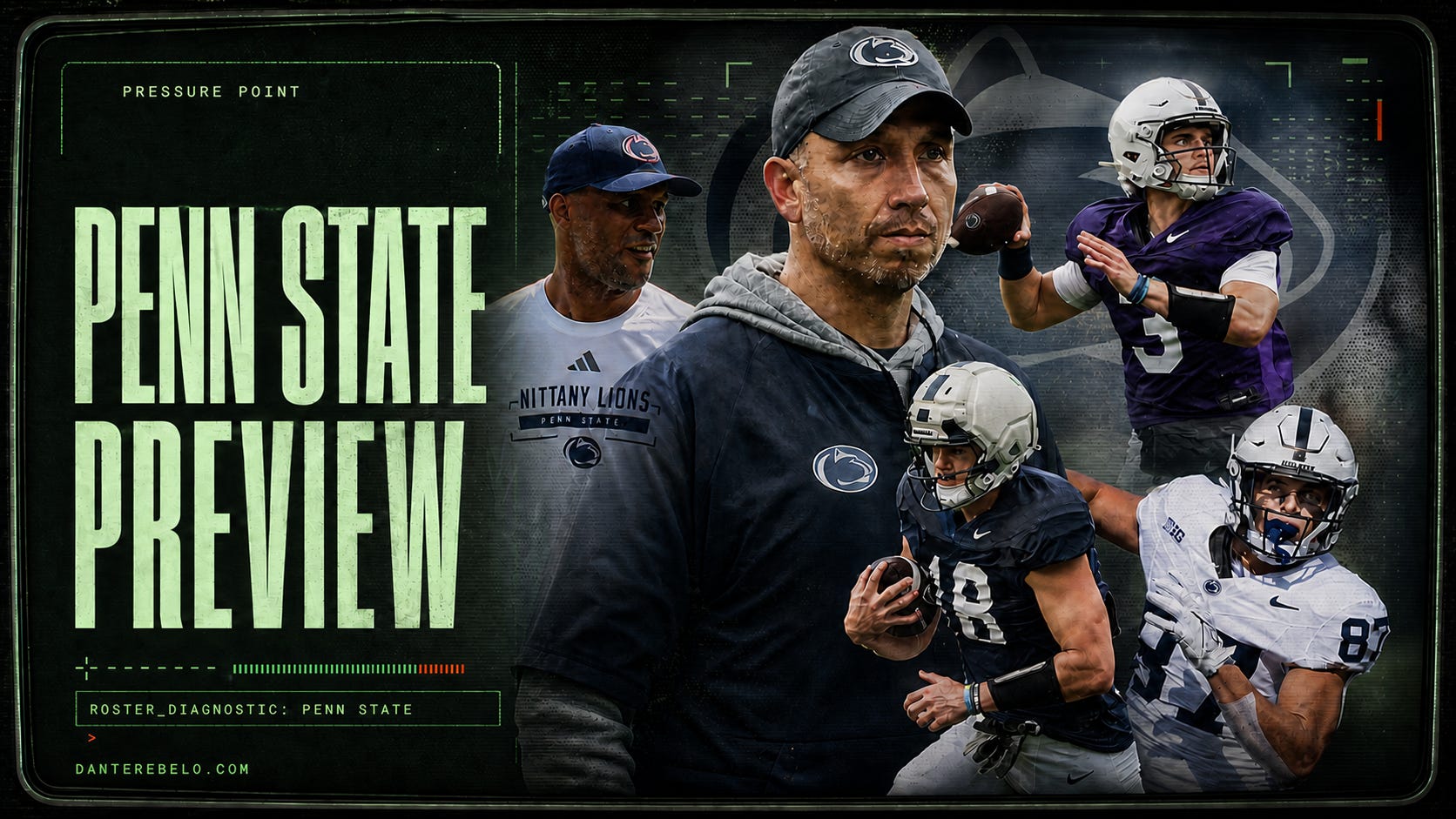
For the first time in over a decade, Penn State Football finds itself heading into a new season with more unknowns than familiarity. After going “all-in” for 2025 and falling flat on its face, Penn State made the decision to get out of the James Franklin business. After a tumultuous coaching search, with many twists and turns, the Nittany Lions ended up with someone that should have been at the top of their candidate list from the beginning—Iowa State’s Matt Campbell. Campbell brings a fresh approach, renewed energy, and an embrace of the past that has long been missing in Happy Valley. With under a month until the Lions kick off against Marshall, there is no shortage of questions and unknowns for the start of a new era.
Five specifically are top of mind. Let’s get into it.
Can all these new players and coaches come together and form a playoff team?
Even in a sport that now features dramatic annual roster turnover, Penn State is dealing with a complete roster overhaul following the dismissal of James Franklin last October.
Only 22% of Penn State’s 2025 snaps were played by players who are returning, but with Campbell bringing 24 former Iowa State players with him to Happy Valley, Penn State’s transfer-adjusted returning production is 52%, right around the national average.
The most interesting part of Matt Campbell’s first season is that this is an almost entirely new Penn State team, but one that is made up of players with experience. 39 transfers in total joined the Lions from the total, with 24 coming from Iowa State. The offense figures to mesh rather quickly, as quarterback Rocco Becht, running back Carson Hansen, tight end Ben Brahmer, and a trio of wide receivers are included in that group of Cyclone transfers. The fact that offensive coordinator Taylor Mouser also followed Campbell makes a smooth transition even more viable. This is a sizable chunk of an offense, playing in the same system they have for the last few years.
The defensive side of the ball is a different story. In addition to a heavier combination of existing Penn State players and former Cyclones. Penn State must replace 75% of last season’s defensive snaps under an almost entirely new staff. That is no easy task. If star linebacker Tony Rojas is fully recovered from an ACL tear, that should help, but PSU needs its defense to gel fast, and does not have the benefit that the offense does with a large group of players who have played together in the same system before.
A forgiving opening schedule against Marshall, Temple, and Buffalo should help, but the warm ups end quickly when USC comes to town in October for Campbell’s first ‘White Out’ game.
If Penn State can ultimately make the playoff in year one under Campbell, it will be because its experienced offense led the way while the defense found cohesion quickly.
How good is Rocco Becht?
Football analysis always starts with the quarterback. Aside from the truly elite teams, it is hard for a team to perform above its quarterback play.
Becht is interesting because the Lions are not getting a total question mark, but he is not a total safe bet without any downside either.
Before the shoulder injuries last year and for most of his career, Becht produced like a perfectly capable college quarterback. You’d be forgiven for seeing a little Trace McSorely in his game - mobile enough to avoid sacks, dangerous enough to use play-action, and productive enough to rack up above-average passing statistics, but never really being in elite quarterback discussion. That mobility should be highly beneficial in Mouser’s offense, as it helps open up the passing game in ways Penn State could not consistently do in the Drew Allar era.
The biggest question is Becht’s health and how high his ceiling ultimately is.
Becht had two shoulder injuries last season that required offseason surgery, so it is a viable concern whether his body can hold up in the Big Ten for a full season. Can Becht look like the 2024 version of himself against better defenses than he saw in the Big 12? His numbers against winning Power Four opponents last year leave a lot to be desired: 6 touchdowns, 7 interceptions, a sub-60% completion rate. The numbers after the injuries are worse, with his completion percentage falling by 10 points and his QBR dropping nearly 40 points.
Once conference play starts, even the lower-tier Big Ten opponents will represent a stronger challenge than the defenses Iowa State frequently played, and if Penn State is truly going to contend for the playoff, Becht and the offense will need to lead the way.
Penn State does not need Becht to be a Heisman candidate, but it does need the healthy version of the quarterback who already has 39 career starts and more than 9,000 passing yards. It will need a signal-caller who plays his best against the best, something they have lacked since Trace McSorely.
Can Penn State’s tight ends be the best group in the country?
Tight end was one of the strongest position groups under James Franklin, and the good news for Penn State fans is that seems to be the case again at the start of the Matt Campbell era.
Proven production, huge talent ceiling, and overall depth make the group the easy pick for strongest position group on offense. An offensive scheme that heavily features them figures to also provide the opportunity for this position group to be one of the best in the country.
Ben Brahmer leads the way, with the former Cyclone coming to Happy Valley after registering nearly five hundred receiving yards, six touchdowns, and a Mackey Award semifinalist nod last year. His massive 6-foot-7, 250-pound frame and familiarity with Becht and the offensive system set him up well to become one of the best tight ends in the country.
Returning junior Andrew Rappleyea represented one of the few bright spots after Franklin was fired. Deciding to remain in the blue and white, Rappleyea shone down the stretch in 2025. In my opinion, he actually stood out more than former five-star recruit Luke Reynolds at the position, and keeping him at Penn State was a huge win for Campbell and Co.
Having two extremely athletic vertical threats in the middle of the field creates a matchup nightmare for defenses. While Brahmer and Rappleyea give the group upside, another former Cyclone, Gabe Burkle, adds a physical blocking presence that should help Penn State in the run game. Burkle also has shown competence in pass-catching, allowing Taylor Mouser even more versatility in scheming all three tight ends for Becht to target.
Which brings us to the question I asked earlier: can this group be one of the best in the country?
The floor looks plenty high, but it will fall on Mouser, who, in addition to being the OC, is also the tight ends coach, to get the most out of the group and take advantage of its strengths.
If he can figure out ways to get both Brahmer and Rappleyea involved in the passing game in multiple-tight-end sets, it will create problems for the defense and should open up things for the receivers and running backs.
If this group is going to be not just really good but truly elite, Brahmer and Rappleyea will have to build on their previous production, take advantage of an offense built around them, and become legitimate offensive weapons that linebackers can’t cover.
Can the a completely new group learn the system, and figure out a way to generate pressure?
Where Penn State’s offense can lean on familiarity between players and scheme, the defense has no such luxury. Campbell hired former Penn State defensive back D’Anton Lynn from USC, bringing in a letterman with a resume of turning around struggling defenses at his previous stops at UCLA and USC.
Installing and teaching new schemes on defense are challenging enough (see last year with former coordinator Jim Knowles), but Lynn needs to find a way to get 25 new defenders on the same page and comfortable as quickly as possible.
So far, Lynn has preached “obnoxious communication,” and has talked about wanting to avoid putting players in a position to make an assumption on the fly, leading to an explosive play against (something that too often happened last year).
The results of his ability to quickly improve a defense can be found at Lynn’s previous stops—improving first-year scoring defense by 10.6 fewer points at UCLA and 10.3 at USC.
No matter how good a teacher Lynn is, he is not going to be able to teach his way to an effective pass rush.
The Lions should have a strong secondary with returning Penn State stars and Iowa State transfers, the biggest question mark for the Lions will be at edge rusher. Yvan Kemajou and Max Granville return to Penn State, and Ikenna Ezeogu joins from Ames. Granville represents the highest upside, but someone out of this group will need to elevate his play.
Gone is Dani Dennis-Sutton, who led the team with 8.5 sacks last year.
After registering 0 sacks against Ohio State, Iowa, and Oregon in 2025, Penn State needs someone out of this group to emerge as a pressure creator. Too often opposing quarterbacks last year found themselves comfortable and able to make progressions unimpeded on third-and-long—who among this group can rise up and fill that void in 2026?
Lynn’s history of getting defenses to improve quickly at USC and UCLA should ease concerns for the Lions, and evidence suggests a quick transition is realistic.
A talented linebacker corps (led by returning playmaker Tony Rojas) and secondary (star safety Marcus Neal Jr., an Iowa State transfer) cannot compensate for a lackluster pass rush, something Penn State learned all too well last year.
By the time the Nittany Lions face the back-to-back games against USC and Michigan —someone out of this group of edge rushers and defensive linemen will need to be the difference-maker.
What would be a successful first season for Campbell?
Coaches are usually granted a grace period in their first year on the job. The coach needs time to establish their own culture and standards, bring in their own recruits and players, and develop a cohesive staff that can carry out their vision.
Matt Campbell has done a great job endearing the fan base to his cause, preaching the importance of “values” and “character.”
However, when the ball is spotted on September 5th for the first game against Marshall, all of those mantras and soundbites become “nice-to-haves” and the results take precedence.
Campbell has the challenge of going from being a program builder and savior in Ames to being in charge of steering one toward a national championship.
He is replacing a coach who routinely won double-digit games, but seemed incapable of figuring out a way to get Penn State in the upper echelon of college football.
Given PSU’s fairly weak schedule—which avoids Ohio State, Oregon, and Indiana— the absolute floor for this team should be 9-3 (assuming losses to USC, Michigan, and Washington).
Given the continuity on offense and the talent and experience on defense, Penn State should be able to challenge for a playoff berth—which would be a tremendous accomplishment in the first year of a new coaching era.
I fully expect the Lions to be in the mix at 10-2 for one of the lower playoff positions.
If Becht and the offense can be better than expected and some young returning Penn State players reach their projected ceiling under a new staff known for development, Penn State could flirt with 11 wins.
If the Nittany Lions finish below 9 wins, it will likely be because the sheer amount of change causes the team to never figure out an identity, Becht and the offense aren’t able to elevate in conference play, and the defense never finds its difference-maker.
After twelve years, the James Franklin era needed to come to an end. It was clear to anyone with a pulse that after a heartbreaking loss against Oregon last year, the Franklin era was effectively over. That the team lost back-to-back games against winless UCLA and Northwestern as 20-point favorites merely shows how fragile the program was with elevated expectations. Campbell’s hiring has generated a wave of optimism and excitement, but in a few short weeks, we will get answers to the questions above and many more, and the results will speak for themselves.
Matt Campbell, after a circuitous coaching search to bring him in, has done and said all the right things. He has made a career out of being a guy “who does more with less.” He will now be expected to do “more with more” and elevate one of the most historic football programs from the really good to the great.
While I've never been a PSU fan, I'm a big Matt Campbell fan! Good questions; 10-2 is still a tall order in year 1, but hey, Cignetti has set a new standard at 11-2 in year one at Indiana...hope Campbell does well.