


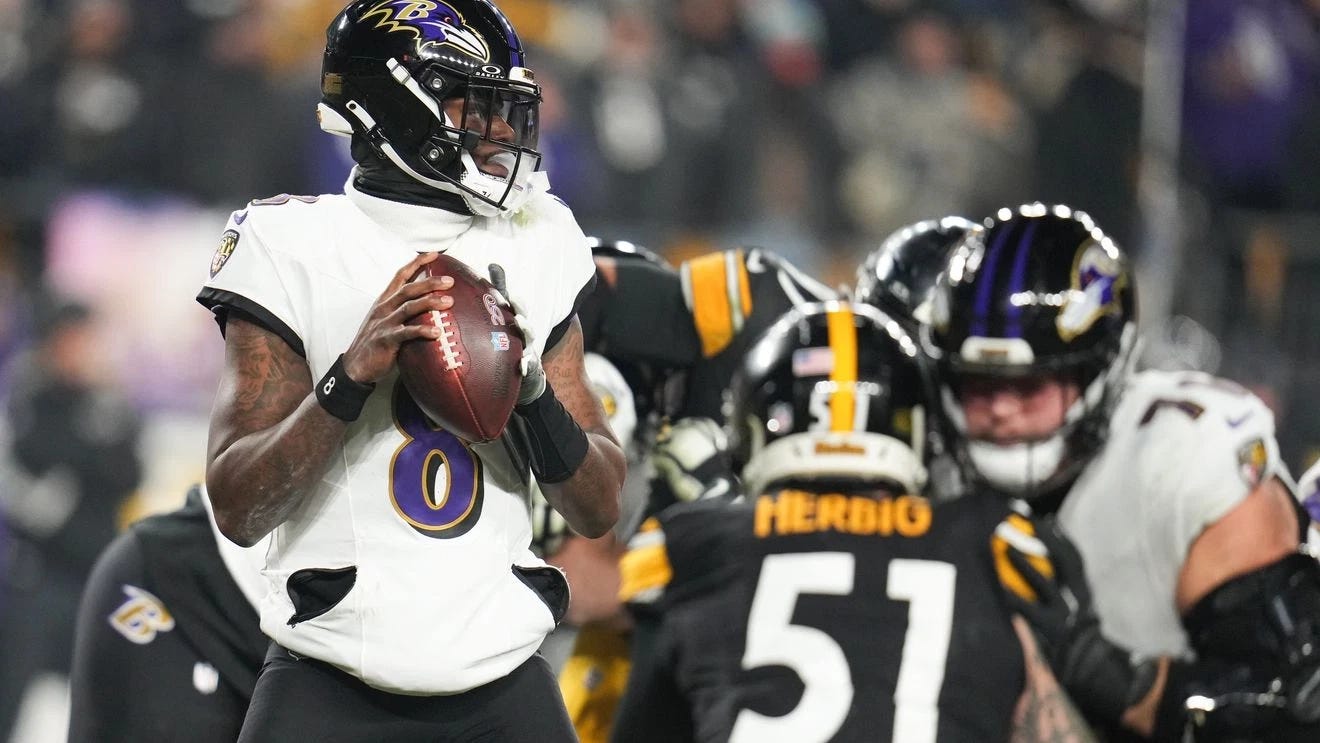
He could only watch. After Lamar Jackson hit Isaiah Likely for 26 yards on fourth-and-7 to drag the Baltimore Ravens past midfield, the season—and maybe the franchise’s championship window—came down to the leg of a 24-year-old kicker.
Seconds earlier, it felt over. Jackson kept it alive anyway, the way he has for years: one impossible play, one more chance.
Tyler Loop’s 44-yard attempt sailed wide right. On the other sideline, the Pittsburgh Steelers celebrated a division title. Jackson and the Ravens stood still, watching another season end the same way so many of his have: with the margin thin, the stakes enormous, and the result empty.
It didn’t feel like only a season slipping away. It felt like time—and Lamar’s prime—slipping with it.
The myth, especially in the Tom Brady era, is that quarterbacks can play into their 40s and keep the whole thing going. The reality is simpler: even for elite quarterbacks, the number of truly dominant seasons is finite. In two days, Lamar Jackson turns 29.
He’s already built a generational résumé: Heisman winner, two-time NFL MVP, the youngest quarterback to win a unanimous NFL MVP, and the fastest player to reach 5,000 passing yards and 2,000 rushing yards. Drafted at the end of the first round in 2018, Jackson didn’t just become a franchise quarterback—he redefined what one could be, becoming the first QB in league history to post multiple 1,000-yard rushing seasons.
The regular-season success is unquestionable. But in Jackson’s seven seasons, the Ravens have one AFC Championship Game appearance to show for it. They still haven’t reached a Super Bowl in the Lamar era.
Despite record-breaking regular-season numbers, the playoffs have proved a tougher stage for Jackson.
Lamar’s postseason record sits at 3–5. His efficiency drops in January, and the possession-killers pile up—interceptions, fumbles, the kinds of negative plays that decide playoff games. In his lone AFC Championship appearance, against Kansas City after the 2023 season, he threw for 272 yards with one interception in a 17–10 loss. It wasn’t a total no-show. It was something worse: close enough to make it hurt, not clean enough to win.
The story has repeated in different forms. In the 2019 Titans upset, Derrick Henry ran for 195 yards while Baltimore’s defense caved. Other years, the breakdowns have come from dropped opportunities and mistakes around him. The feeling persists anyway. For all his generational talent, Baltimore hasn’t capitalized when the stakes rise and the field shrinks.
And 2025 stings worse because it feels like the type of season contenders are supposed to cash. The AFC has felt as open as it’s been in years. The Ravens still came up empty. The best shot he’s had ended the same way the season ended—pushed wide right.
The urgency isn’t just narrative. It’s physical. What makes Jackson brilliant also makes the window fragile.
The injuries have added up. An ankle injury cost him the final stretch in 2021. A PCL sprain ended his 2022 season and kept him out of the postseason. This year, he missed four games, including a multi-week absence with a hamstring injury, and late-season back and knee issues have visibly complicated the way he wins. The point isn’t that Lamar is no longer elite. It’s that the margin that separates “elite” from “unstoppable” is getting harder to guarantee year after year.
You can see it in the shape of the season: fewer of the effortless, game-breaking runs; less weekly inevitability; more games where he has to be perfect because the rest of the roster can’t afford a single crack. Every hit matters more. Every small limitation changes the math.
And the precedent is unforgiving. Quarterbacks who rely on mobility don’t usually fall off all at once—they lose a half-step, then a second reaction, then the ability to erase mistakes with one play. Cam Newton is the cautionary tale everyone remembers, but the league is full of versions of this story: dynamic quarterbacks whose prime advantage shrank the moment injuries and mileage started stacking.
The roster math is tightening, too. Jackson’s 2026 cap hit is projected to be massive, and even if Baltimore reshapes it, the pressure doesn’t disappear—it shifts. The Ravens will have to make real decisions on who they can keep, who they can extend, and how deep the supporting cast can stay when the quarterback occupies that much of the budget. In a league where depth wins in January, that matters.
Jackson is only 29, and maybe this was just bad luck. But between the injuries, the cap squeeze, and an AFC that’s getting younger and hungrier every season, this might have been their best shot—or at least one of the last “clean” ones where the Ravens could count on having every advantage at once.
Sunday night, the kick sailed wide right. And Jackson might have watched another year of his prime disappear the same way.