


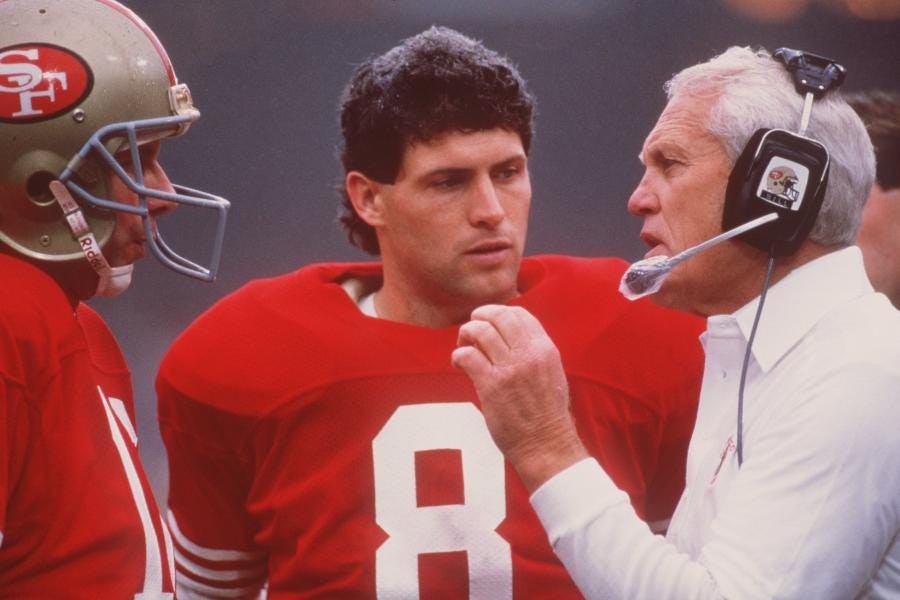
What if I told you that one of the most successful and impactful leaders in sports history, someone who completely revolutionized the game of football, has been almost forgotten outside of die-hard football circles? In the pantheon of NFL coaching legends, one figure looms large that remains critically underappreciated for his impact on the current state of professional football. Before Bill Belichick became the hooded emperor of New England, before Andy Reid transformed Kansas City into his personal offensive laboratory, there was William Ernest Walsh – a man who didn't just win games, but fundamentally rewrote the NFL's offensive DNA, and how successful organizations are run.
San Francisco, January 1979. The 49ers were a football catastrophe, fresh off a soul-crushing 2-14 season that had fans questioning their life choices. In a move that must have seemed like either desperation or madness, the team hired the head coach of the Stanford Cardinal – their collegiate neighbor – as both its head coach and general manager. It was like asking your local college professor to run NASA.
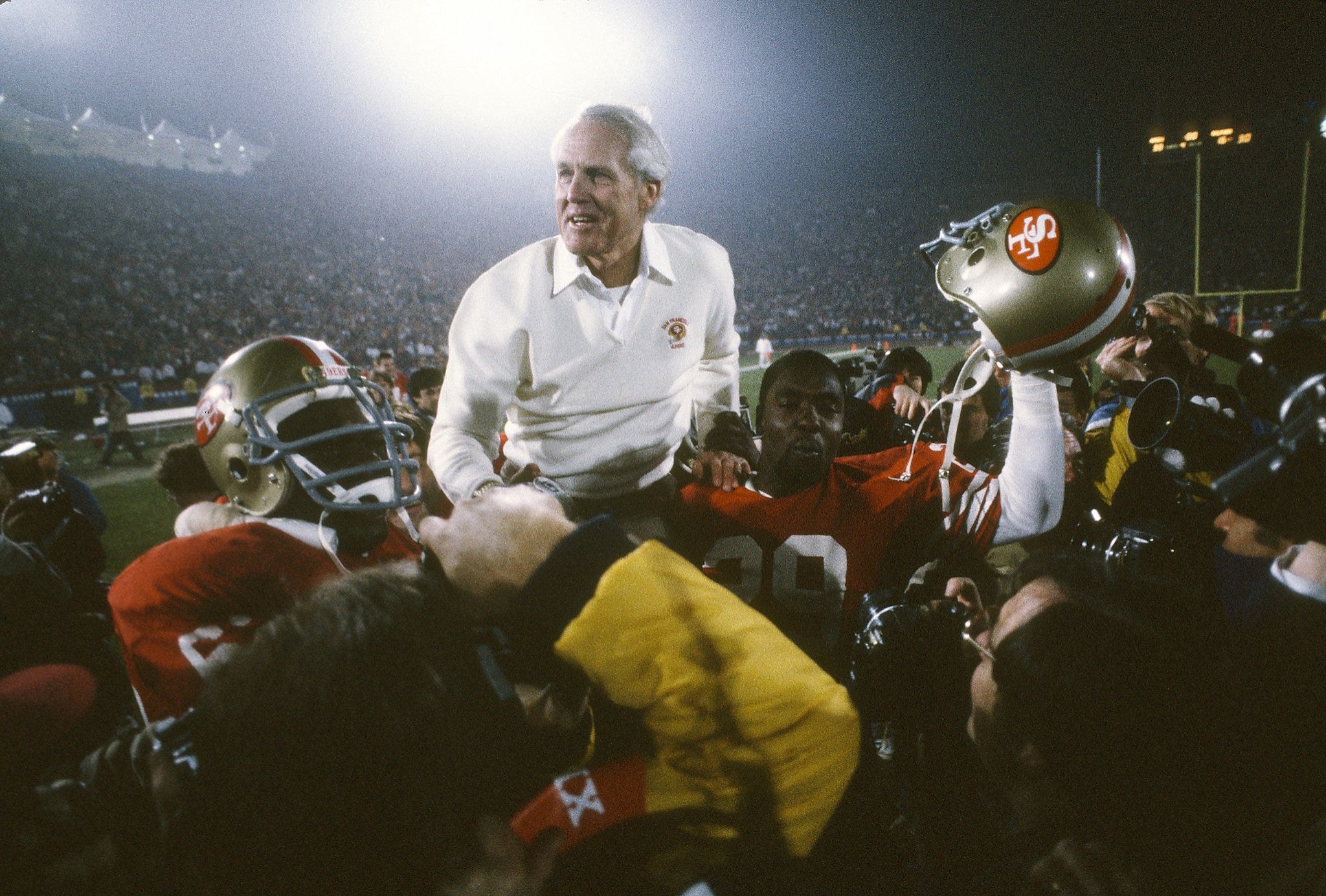
What followed wasn't just a turnaround; it was football and organizational alchemy. Walsh transformed that lead-footed team into pure gold, crafting a dynasty that would capture four Super Bowl championships through the magical arms of Joe Montana and the otherworldly talents of Jerry Rice. But Walsh's true masterpiece? It wasn't the trophies, or the quick passing game – it was the minds he molded, and cultural DNA he infused into the organization.
Look around the NFL in 2025, and you'll see Walsh's fingerprints everywhere. His coaching tree isn't just a tree; it's become an entire ecosystem. Andy Reid, who just narrowly missed matching Walsh's Super Bowl count this past weekend, runs an offense that Walsh would recognize as his own grandchild. Sean McVay, the boy wonder of modern coaching, leads a new generation of Walsh disciples who spread across the league like winning-obsessed offensive missionaries every off-season.
"The Score Takes Care of Itself," Walsh's memoir, isn't just another sports book – it's a blueprint for excellence that transcends the gridiron. It's a masterclass in building sustained success, whether you're calling plays on Sunday or leading a team in the corporate world. Within its pages lies the architecture of greatness: perfecting the smallest details, elevating those around you, and maintaining ice-water composure when the pressure peaks.
What follows are the essential lessons from Walsh's playbook for success – a guide to climbing your own personal mountaintop, whatever that peak may be. As the master himself would say: focus on the fundamentals, empower your team, keep your cool, and watch as the score, inevitably, takes care of itself
.
Raising the Standard: When Excellence Becomes a Habit
Picture the worst meeting you've ever sat through. Now imagine that level of mediocrity infecting an entire NFL franchise. That was the 1978 San Francisco 49ers – an organization where "good enough" had become the unofficial motto. Into this den of mediocrity walked Bill Walsh, armed with what seemed like an absurd philosophy: perfection isn't just possible; it's mandatory.
Walsh didn't just want to win games; he wanted to fundamentally rewire how every single person in the building approached their job. His radical idea? Championships aren't won on Sundays – they're won in the mundane moments no one sees. The secretary's phone etiquette mattered just as much as Joe Montana's footwork. The janitor's attention to detail was as crucial as the linebacker's tackling technique. Walsh understood that excellence isn't an act, it's a habit that spreads like a virus through an organization.
Here's the kicker that separates Walsh's philosophy from your typical corporate motivational poster: he knew that obsessing over the scoreboard was like watching a pot waiting to boil. Instead, he preached what I'll call the "Walsh Paradox" – the more you focus on perfecting the small details, the more the big results take care of themselves. It's counterintuitive, but think about it: How many times have you blown a presentation because you were too focused on the outcome rather than the preparation?
The most crucial lesson here? Champions don't wait for success to start acting like champions. Walsh flipped the script on the traditional "we'll act better when we start winning" mentality. His message was clear: you want to be a champion? Start behaving like one right now, especially when no one's watching. Whether you're running a Fortune 500 company or managing a local coffee shop, the principle holds true – your habits and standards today create your results tomorrow.
This wasn't just feel-good motivation; Walsh implemented specific standards across every level of the organization:
Every phone call had to be answered within three rings
Meeting schedules were precise to the minute
Practice drills were choreographed with the detail of a Broadway show
Even the team's travel arrangements were treated with the same precision as a playoff game plan
The results? Well, those four Super Bowl rings weren't accidents. They were the inevitable outcome of thousands of perfectly executed small moments.
Process Proceeds Perfection: When The Journey Becomes The Destination
In 2025, every LinkedIn guru and their spiritual advisor is preaching about "trusting the process." It's become the corporate equivalent of a pop song chorus – catchy, overplayed, and usually stripped of its original meaning. But back in 1981, when Bill Walsh started preaching “process over outcomes”, it was like telling people the earth was flat. In the win-now-or-else NFL, suggesting that winning wasn't the primary goal was coaching heresy.
Here's what made Walsh different: he understood that telling a 2-14 team they were going to win the Super Bowl was like telling a couch potato they were going to win the Boston Marathon. It's not just unrealistic – it's demotivating. Instead, Walsh broke down the mountain of excellence into manageable molehills. Perfect this one play. Master this specific technique. Nail this particular meeting structure. Suddenly, perfection wasn't some distant peak shrouded in clouds; it was something you could envision and feel in your daily work.
Think about it like this: if you're learning to play piano, you don't start by attempting Beethoven's 9th Symphony. You start with "Mary Had a Little Lamb," and you practice it until your family begs for mercy. Walsh applied this same principle to professional football. Rather than obsessing over the scoreboard (which, let's be honest, wasn't showing great numbers at the time), he got everyone focused on the individual notes that would eventually create the symphony.
The real magic happened when this mindset spread through the entire organization like a parasite of excellence. From the equipment managers to the star quarterback, everyone started seeing their role through the lens of process rather than results. It was a total mindset flip: instead of "we need to win Sunday," it became "we need to execute this specific practice perfectly, right now."
Here's the kicker – and this is where Walsh was truly ahead of his time – he understood that culture change isn't about motivational speeches or fancy slogans painted on the wall. It's about getting people to actually believe in and commit to a different way of thinking. The 49ers didn't just talk about the process; they lived it. Every. Single. Day.
When the shift finally happened, when the entire organization bought into this philosophy, it was like watching dominoes fall in slow motion. Suddenly, those perfect practices turned into perfect plays, which turned into perfect games, which – wouldn't you know it – turned into wins and championships. But Walsh's genius was getting everyone to stop staring at that last domino and focus on setting up each piece exactly right.
This isn't just football philosophy – it's a blueprint for any massive undertaking. Want to transform your business? Start with perfecting your Monday morning meetings. Want to revolutionize your industry? Master the basics first. The summit starts looking a lot less intimidating when you're focused on taking the next step rather than staring at the peak.
The Mad Scientist of Football: Why Failure Is Your Best Laboratory
Ever watch those old cartoons, where the mad scientist keeps blowing up their lab, only to excitedly scribble new notes? That was Bill Walsh with the 49ers. While most coaches treated failure like a career-ending disease, Walsh saw it as his most reliable research assistant. In an era when NFL coaches protected their egos like medieval kings guarding their crowns, Walsh was out here treating the football field like his personal laboratory, complete with explosions and all.
Here's what made Walsh's approach revolutionary: he didn't just accept failure – he actively courted it. Think about that for a second. In the win-or-get-fired world of the NFL, this guy was treating losses like data points in a grand experiment. Imagine walking into your boss's office after a massive screw-up and saying, "Great news! We've discovered another way that doesn't work!" That's essentially what Walsh was doing, and somehow, he got an entire organization to buy into this mindset.
But here's where most of us get it wrong. We say things like "fail fast" and "learn from your mistakes" while secretly hoping we never have to actually do either. We treat failure like a bad Tinder date – acknowledge it happened, maybe tell a funny story about it, then try to forget it ever existed. Walsh? He'd dissect that bad date like he was writing a doctoral thesis on it.
The secret sauce in Walsh's approach was his ability to separate ego from analysis. After a loss, he'd allow himself exactly 24 hours to feel the emotional gut punch (because he was human, after all). But then? Then came the fascinating part – he'd zoom out to what he called the "10,000-foot view" and analyze that failure with the cold precision of a forensic investigator. Every incomplete pass, every missed block, every blown coverage became a clue in solving the larger puzzle of excellence.
Consider this: How many times have you glossed over feedback because it stung your pride? Walsh would argue that the information that hurts the most is usually the information you need the most. It's like getting a cavity filled – nobody enjoys the process, but ignoring it only makes things worse.
The real genius of Walsh's approach was understanding that the path to victory isn't a straight line – it's more like a drunk person's walk home, with plenty of zigzags and occasional stumbles. But each stumble, each wrong turn, contains valuable data about how to walk better next time. His process was never fixed; it was constantly evolving based on new information, even if that information came wrapped in the package of a humiliating defeat.
This isn't just football philosophy – this is a master class in personal and professional growth. Want to build something great? Start by building yourself a better relationship with failure. Make it your research partner, not your enemy. Because as Walsh proved, those painful moments of feedback aren't just setbacks – they're the seeds of future success, buried in the soil of temporary defeat.
Innovation Through Limitation: How Walsh Turned "Can't" Into "Changed the Game"
Let's talk about the greatest invention in NFL history that started with a bug and became a feature. While most of us treat limitations like a bad hand in poker, Bill Walsh saw them as an invitation to rewrite the rules of the game. And I mean that literally – the man essentially reinvented professional football because his quarterback's arm had all the power of a kid's water pistol (prior to drafting Joe Montana).
Here's where Walsh's genius hits different: Most coaches back then would've seen a quarterback who couldn't throw deep and thought, "Well, we're screwed." Walsh looked at the same situation and thought, "Time to blow up the entire concept of offensive football." That's like looking at a car with no engine and inventing the bicycle – sure, it wasn't the original plan, but now you've got something that might actually work better for certain situations.
The West Coast Offense – Walsh's masterpiece of football innovation – wasn't born in some ivory tower of perfect conditions. It was born out of desperation, like most great innovations. Instead of waiting for the perfect quarterback with a howitzer for an arm, Walsh essentially said, "What if we turned our weakness into our identity?" He created an entire offensive system built around quick, short passes that made his quarterback's limitations irrelevant. It's the football equivalent of turning lemons into lemonade, except in this case, the lemonade ended up becoming the official drink of the NFL for the next four decades.
(Quick pause for a mind-bending thought: If Walsh had gotten that prototypical strong-armed quarterback, we might be living in a completely different football universe. Patrick Mahomes might be playing shortstop for the Kansas City Royals right now, and Andy Reid might be known primarily as a mustache model. The butterfly effect is wild, folks.)
This is where Walsh's philosophy diverges from most of our instincts. While many of us (myself included) treat change like it's a sickness we need to avoid, Walsh treated it like a stimulant. New problems? Great! Fresh constraints? Even better! Each limitation was just another invitation to innovate. His constant question – "What assets do we have right now that we're not taking advantage of?" – wasn't just coach-speak. It was a revolutionary way of looking at problem-solving.
The lesson here isn't just about football – it's about reframing how we view limitations in our own lives. That budget cut at work? Maybe it's your chance to reinvent your department's approach. That project with impossible constraints? Could be your opportunity to create something nobody's ever thought of before. Walsh would argue that our best innovations often come not when we have everything we need, but when we're forced to get creative with what we have.
Remember: Conventional wisdom gave us conventional football. It took someone looking at their limitations and saying, "What if this isn't actually a problem?" to change the game forever. The next time you're facing a limitation, try channeling your inner Walsh. Instead of waiting for perfect conditions (spoiler alert: they never come), ask yourself what you could create with exactly what you have right now. Also yeah, getting that Joe Montana guy probably made things slightly easier.
The Quiet Revolutionary: How Walsh Changed the Game by Lowering His Voice
In the 1980s NFL, most coaches thought they were auditioning for a role in "Full Metal Jacket." The standard coaching playbook read like a “greatest hits” of military tactics: scream until you're red in the face, question players' manhood, and maybe throw a clipboard or seven. Into this testosterone-fueled atmosphere walked Bill Walsh, armed with a radical idea: What if we treated professional athletes like... professionals?
This wasn't just a style choice – it was a complete reimagining of what leadership could look like in pro football. While other coaches were doing their best drill sergeant impressions, Walsh was treating his organization like a Fortune 500 company where everyone, from Jerry Rice to Janet in accounting, was a valued team member working toward a common goal.
Here's where Walsh's approach gets really interesting: He understood something fundamental about human nature that many leaders still haven't figured out in 2025. His philosophy was simple but profound: "You Can't Grow a Garden By Only Picking Weeds." Think about that for a second. Most bosses are excellent weed-pickers – they can spot what's wrong from a mile away. But Walsh realized that pointing out flaws is only half the equation. People, like plants, need nourishment to thrive.
(Quick aside: Imagine being a 49ers player in 1981, expecting to get chewed out for a mistake, and instead getting a calm, reasoned analysis of how to improve. It must have felt like walking into detention and finding out it's actually a pizza party.)
The real magic of Walsh's approach was in his ability to combine sky-high standards with genuine belief in his people. He'd tell a third-string cornerback they needed to execute their technique perfectly – not as a threat, but as an expression of confidence in their ability to reach that level. It turns out "I believe you can do better" hits different than "What the hell is wrong with you?"
This wasn't some feel-good, participation-trophy philosophy either. Walsh was absolutely ruthless about standards – he just didn't feel the need to be a crazy condescending jerk about how he communicated them. He proved that you can demand excellence without demanding people's dignity in return.
The lesson here extends way beyond the gridiron. Whether you're managing a team at work or coaching your kid's soccer team, Walsh's garden analogy holds true: Growth requires both pruning AND nurturing. Set the bar impossibly high, then give people the support and respect they need to reach it. Because here's the thing – nobody ever looked back on their career and thought, "Man, I really wish my boss had believed in me less."
Never Stop Learning: Walsh's Philosophy of Perpetual Growth
Picture this: It's 1983, and while most NFL head coaches are treating their playbooks and schemes like they're guarding nuclear launch codes, Bill Walsh is running the 49ers like a football university. His coaching staff meetings probably looked more like a TED conference than traditional football strategy sessions – and that was exactly the point.
Walsh had this wild idea that would make most modern managers break out in hives: he actively encouraged his coaches to learn jobs they weren't hired for. Imagine telling your boss you'd like to spend half your time learning someone else's role. Most would smile politely while mentally updating your performance review. Walsh? He'd ask what resources you needed to get started.
This wasn't just professional development – it was organizational evolution on steroids. While other teams were building coaching staffs, Walsh was creating a learning ecosystem. His assistants weren't just position coaches; they were football scholars in a perpetual state of growth. A quarterbacks coach might spend time learning offensive line play, a defensive coordinator studying special teams. It's like Walsh turned the 49ers headquarters into the world's most successful football grad school.
Here's the really crazy part: Walsh knew this approach might actually hurt the team in the short term. Teaching your defensive line coach about offensive schemes means less time drilling pass rush techniques. But Walsh played chess while others played checkers – he understood that short-term efficiency was worth sacrificing for long-term organizational excellence.
(Think about this: When your offensive coordinator understands defensive schemes and your defensive coordinator gets offensive philosophy, you've basically created a coaching staff of bilingual football speakers. That's how innovation happens.)
Walsh's approach to learning wasn't just about formal education either. He treated every interaction, every game, every opponent as a potential master class. Win or lose, there was always something to learn. That annoying thing your rival does? Might be worth stealing. That mistake your competitor made? File that away under "what not to do." Everything was data for the perpetual student.
Most leaders talk about creating a "learning culture" the way people talk about starting a diet – lots of good intentions, not much follow-through. Walsh actually built it. He knew his coaches would eventually leave for better opportunities. Instead of fighting this reality, he leaned into it, creating a legacy that would spread his philosophy across the league through his departing disciples.
The lesson here isn't just about football – it's about creating environments where growth isn't just encouraged, it's required. Because here's the truth Walsh understood: The moment you think you've learned enough is the moment your competition starts passing you by. In 2025, we'd call this having a "growth mindset." In 1983, Walsh just called it the standard.
The Walsh Effect: How One Man's Philosophy Shaped Modern Football
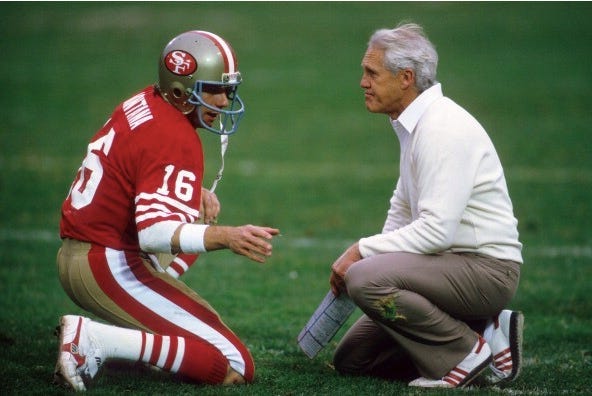
Want to play a fun game? Pick any successful NFL head coach from the last 30 years, and chances are you can connect them to Bill Walsh faster than you can play Six Degrees of Kevin Bacon. Mike Holmgren, Andy Reid, the entire Shanahan coaching dynasty, Sean McVay, John Harbaugh – they're all branches of the same tree, and that tree's roots lead straight back to San Francisco circa 1979.
But here's the thing about Walsh's legacy: reducing it to just the West Coast offense is like saying Steve Jobs just sold computers. Sure, Walsh's offensive system revolutionized football. As the NFL's rules evolved to favor the passing game, his concepts spread through the league like wildfire. But the real magic – the stuff that's still shaping the NFL in 2025 – goes way deeper than X's and O's.
What Walsh really created was a blueprint for organizational excellence that reads like a masterclass in leadership:
Perfect the small things until they become automatic
Embrace failure as your best teacher
Turn limitations into innovations
Lead with respect instead of fear
Never stop learning, growing, evolving
Look at the numbers: The coaches who either learned directly from Walsh or studied under his disciples have collected nine Super Bowl rings between them. But more importantly, they've created their own successful cultures and systems, each putting their own spin on Walsh's fundamental principles.
Vince Lombardi might have the trophy named after him (and rightfully so), and Bill Belichick might have the ring collection (though Andy Reid keeps adding to his jewelry box), but Walsh's influence runs deeper than hardware. He didn't just change how teams play football – he changed how organizations think about excellence.
Walsh's core message: The score takes care of itself. It's not about the scoreboard, the ring count, or the trophy case. It's about the relentless pursuit of perfection in every detail, the constant drive to learn and improve, and most importantly, the understanding that true greatness comes from lifting others up along the way.
In 2025, every time you see a quarterback execute a perfect timing route, or hear about a coach creating an innovative culture of excellence, you're watching Walsh's legacy in action. Not bad for a former Stanford coach who just wanted to make his quarterback's weak arm work.
Great write up!! Really enjoyed the analogies and metaphors - kept it fun 🔥🔥🔥 Great lessons too