


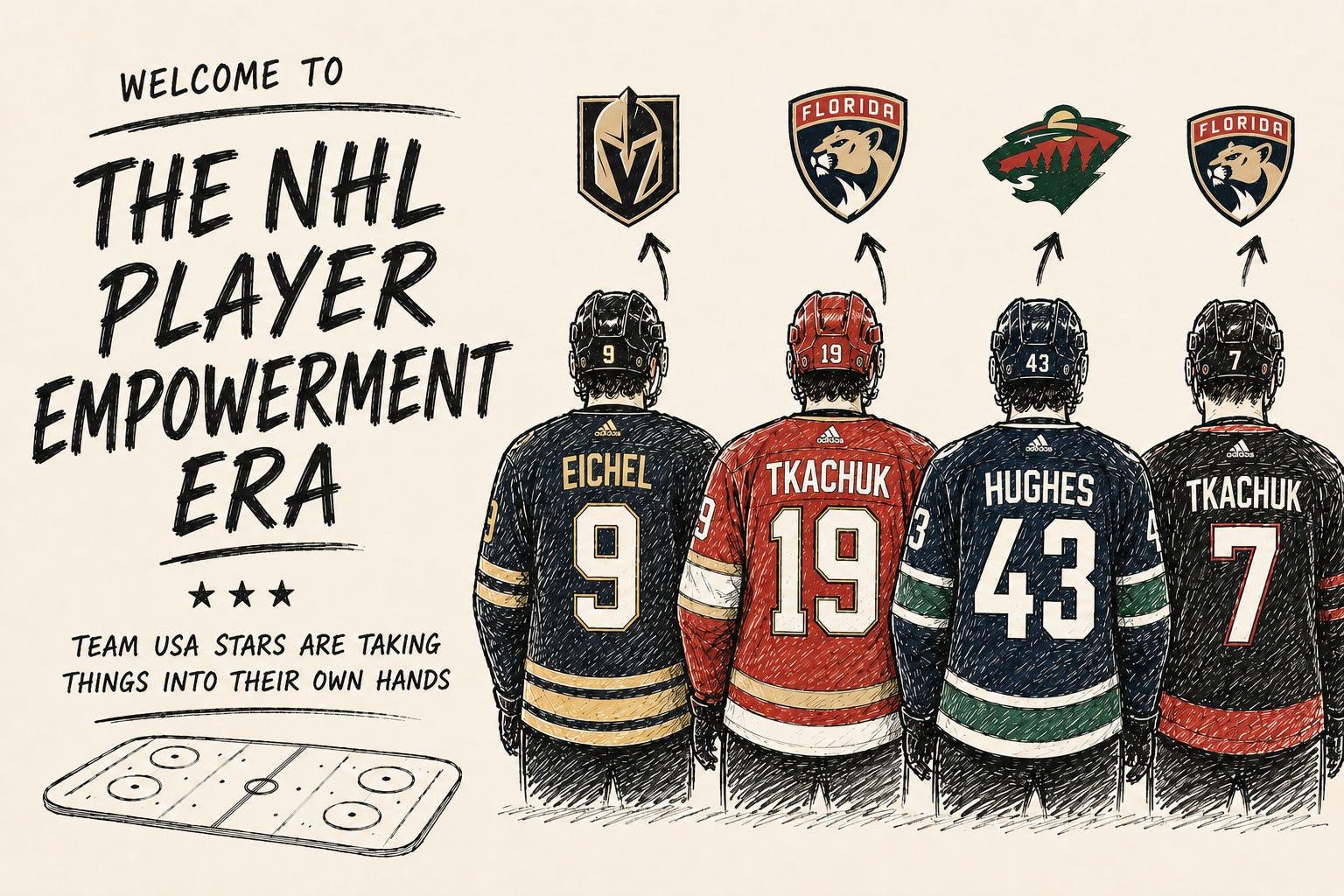
Maybe it has to do with the fact that the National Football League, and the sport of football in general, has such a cultural stranglehold on American interest that basketball and hockey often find themselves in discussion against one another. Every argument a pundit would make for what is wrong with the NBA — player selfishness, massive egos, lack of loyalty to teams and fans, personal ambition over collective success — is what a hockey fan would say is right with the sport. Hockey’s ethos, and by proxy its highest professional league, the NHL, has always believed in the “We” over “Me”, the collective over the individual, playing for the logo on the front of the jersey, not the name on the back. As with most mythos, it doesn’t hold up under scrutiny, but for a long time across the history of the sport there was some truth to it.
With an unprecedented amount of star player movement, most of it being directed by the players themselves, the summer of 2026 represents an evolution of that mythos. The NHL is taking cues from the NBA whose landscape shifted almost two decades ago.
“Player Empowerment” entered the zeitgeist around the NBA in the mid 2010s, where players used unprecedented financial and social leverage to take control of their careers. LeBron James’ “decision” to leave the Cleveland Cavaliers for the Miami Heat in the summer of 2010 via free agency, teaming up with Team USA basketball pals Chris Bosh and Dwyane Wade in Miami, will forever be the crystallizing moment for the new landscape of the league. LeBron, after taking the league by storm, was frustrated with the inability of Cavs ownership and management to surround him with enough support to achieve his championship dreams. After winning a gold medal with some of the other best players in the world, the opportunity for James to play with them full time was too good to pass up. LeBron risked his legacy for a chance to win a championship with fellow stars.
The years following The Decision would see star players no longer sitting back and letting team decision makers drive their career. Now, a star would take an active role in not only where they would play, but who they would play with, and how often. Contract status and term left be damned. The balance of power shifted from organizations, brands, and owners to the players themselves.
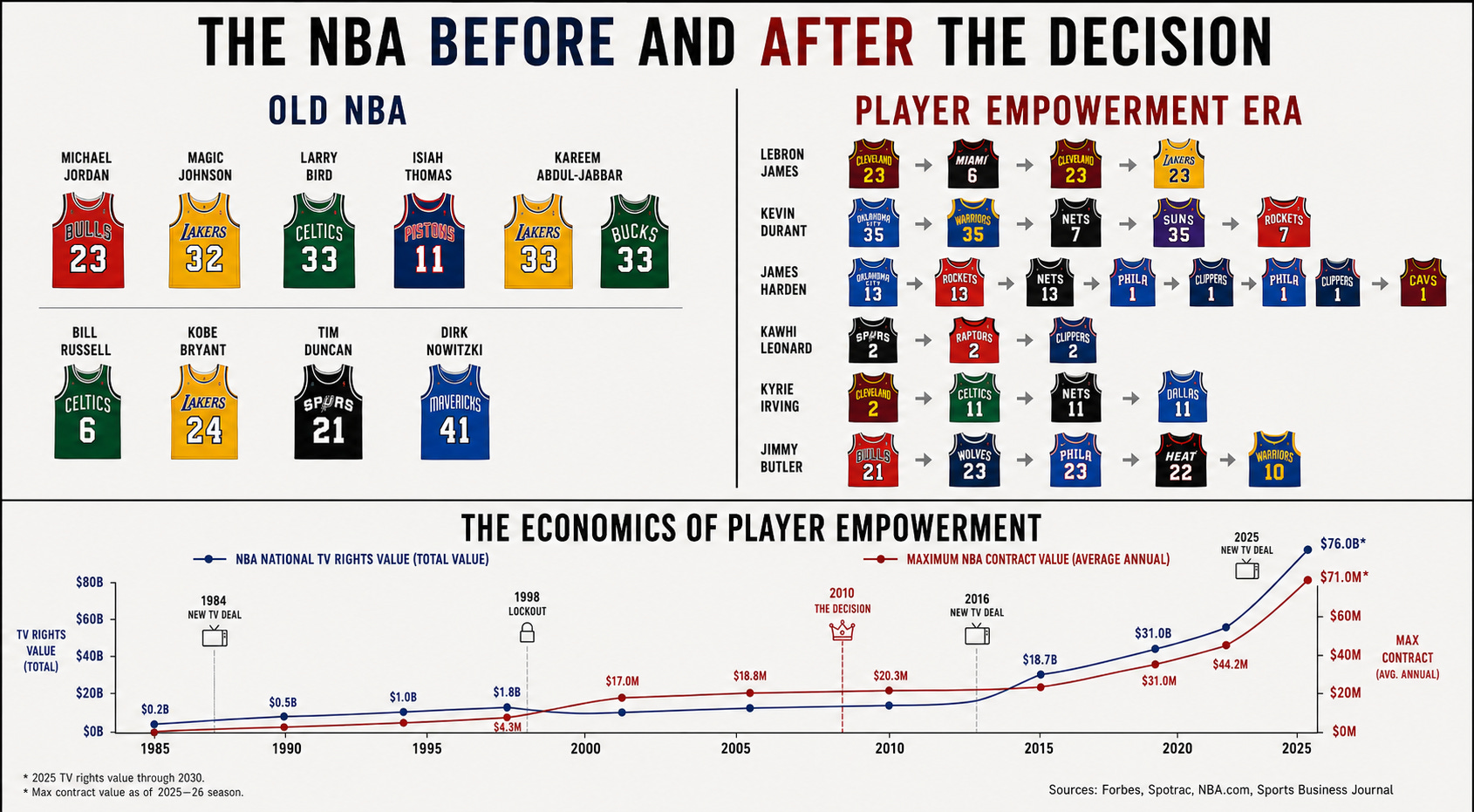
The NHL has roughly lagged the NBA by roughly a decade and a half. But a recent unprecedented swirl of star players driving trades from the teams that drafted them in the middle of their primes signals the NHL is finally entering its own “player empowerment” era. Funny enough, just as LeBron, Wade, and Bosh ruminated on the idea of being teammates after the Team USA basketball gold medal in the 2008 Beijing Olympics, the gold medal winning USA Men’s Hockey team resembles a similar catalyzing moment for reshaping the NHL.
Why then suddenly are star players finally exerting more pressure on front offices and driving their own changes of scenery? Nick Zararis at The Theory of Hockey recently explained that finally after several work stoppages and labor disagreements throughout the 2000s, and the COVID pandemic (the NHL relies on a much higher percentage of their revenue from ticket sales than the NFL and NBA due to the disparity in TV deals), the NHL finally was able to achieve significant revenue growth and a rising salary cap.

Naturally, player salary growth would follow – that explains rising contract values, but not explicitly player movement. That has more to do with changing values, a rapidly shifting hockey landscape, and the modern athlete.
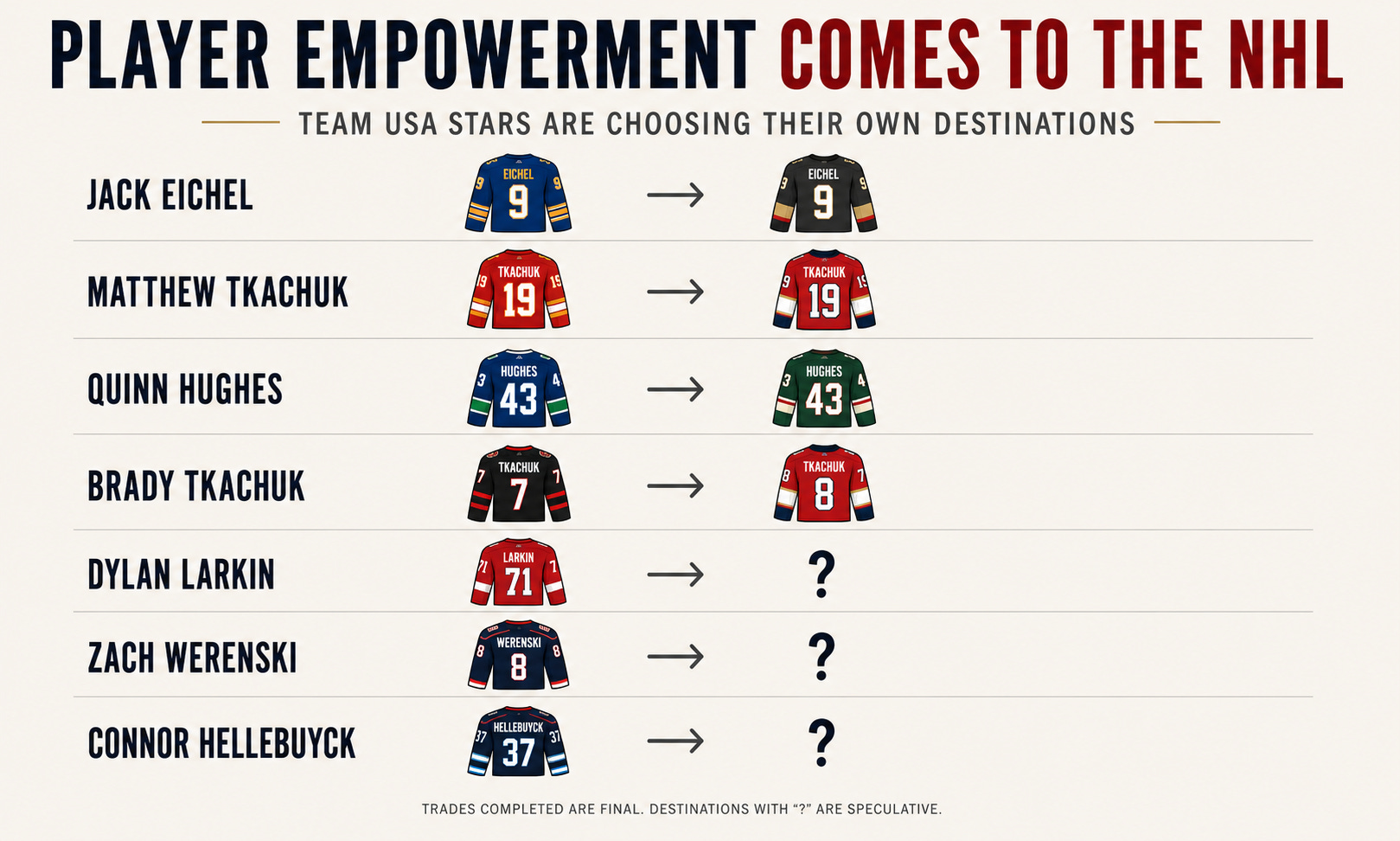
Over the last six months, elite stars Quinn Hughes (traded from Vancouver to Minnesota), Brady Tkachuk (traded from Ottawa to Florida), and Dylan Larkin (still waiting to be traded from Detroit) have all in one way or another forced their way out of a middling situation with the team that drafted them. This follows the path set by fellow Team USA teammates Jack Eichel (Buffalo to Vegas), and Matthew Tkachuk (Brady’s brother, Calgary to Florida) who took control of their own situations and drove trades to new surroundings, and enjoyed almost immediate success.
For the longest time, NHL stars rarely changed teams, and almost never in their prime. If a true superstar did finally don a new jersey, it was in the twilight of their career in an effort to fight off father time and reality of their declining impact. Wayne Gretzky, most often cited as the greatest hockey player ever, was traded to Los Angeles from Edmonton mostly because ownership had driven the franchise into dire financial straits, and would be unable to afford Gretzky’s next contract (to give you a perspective how far the league has come business wise, Edmonton had won four Stanley Cups in Gretzky’s time there, so this was not an example of a team being bad and having no revenues). The Gretzky situation aside, true elite players have historically never changed teams in the primes of their career. In the modern era, Sidney Crosby, Alex Ovechkin, Evgeni Malkin, Steven Stamkos, Jonathan Toews, and Patrick Kane all signed long term, team-friendly extensions to the franchises that drafted them. All could certainly have commanded higher compensation had they gone to free agency; all embodied the hockey ethos that you did the right thing and sacrificed somewhat for the betterment of the team.
Today’s modern athletes, particularly American ones, have grown up in a rapidly changing world. Social media, the idea of an athlete as a brand, things like The Decision, have all forced the mentality that a player can care about the team, but they must also do what’s best for themselves and families. A player now in his late twenties grew up with travel teams and all star squads, the idea of your teams not being defined solely by geography and regionality as they have historically been, but by talent and more often money. The Canadian Major Junior that often attracts the best Canadian talent resembles the NHL, where players are selected and drafted to certain teams who own their rights for that league (despite them not being paid or compensated outside of a small living stipend). The American sports ecosystem, like the country itself, revolves more around free market capitalism.
Whether it is weaponizing a ‘No Movement Clause’ (a term in a player’s contract in which they cannot be traded unless explicitly waiving said clause), or refusing to sign a long term extension with a team trying to trade for them (essentially nuking leverage in negotiations), star players disappointed in the trajectory of their current teams, are taking action.
Some recent examples:
The second overall pick in 2015, Jack Eichel, after spending six playoff-less years as a Buffalo Sabre and being named Captain, requested a trade after disagreeing with the organization’s medical handling of a severe neck injury. Agreeing to sign a long term extension with the Las Vegas Golden Knights, he was traded in late 2021 to the team that had taken the league by storm and was already considered by many a Stanley Cup contender (they had already been to a final in 2018). In his first full season with the Knights, Eichel led all players with 26 playoff points, and hoisted the Stanley Cup as the team’s number one center.
Son of a Hall of Famer, former top ten pick Matthew Tkachuk spent six years in the Calgary Flames organization, and became one of the most exciting young players in the league with his brash physical play and elite offensive skillset. The summer after his second contract expired, and Tkachuk became a restricted free agent, he informed Flames management that he did not intend to sign a long term extension when his contract was up the following year. Never being explicitly stated, Tkachuk clearly wanted to play closer to home and family rather than western Canada. Unlike Eichel’s situation, a star that was stuck on a team that showed no hopes of getting closer to a postseason let alone a championship, Calgary had been to the playoffs multiple times with Tkachuk, and looked poised to contend. Personal desire to play in the U.S. won out, and Tkachuk was traded to the Florida Panthers and in his first three seasons with the team he went to the Final and proceeded to win two Stanley Cups. The move is credited with completely shifting the identity of the organization and turning the Panthers, long a basement dweller, into the perennial aggressive contender they are now.
In Vancouver, after the Canucks fell apart and learned their young superstar Captain Defenseman Quinn Hughes would likely not re-sign at the end of his contract term (1.5 years) – the Vancouver Canucks proactively dealt the defenseman back to the United States to the Minnesota Wild (led by Team USA general manager Bill Guerin, teammates Matt Boldy and Brock Faber) less risk losing him for nothing or deteriorating their leverage over another fifteen months. It had widely been reported Hughes wanted to play in the U.S., and possibly with his star brother(s). The Canucks did not want to see a star walk away for nothing, or have this weigh on the franchise for another year and a half, despite having recently achieved the best record in the league and making it to the second round.
Detroit Red Wings’ Captain and Michigan native Dylan Larkin (under contract with a full no movement clause), frustrated with lack of progress in ending the Wings’ decade long playoff drought, recently requested a trade from his hometown team. The list of teams he reportedly submitted: Minnesota (with Hughes), Florida (with Tkachuk, recent Cup winner and finalist), Tampa Bay Lightning (perennial Cup contender in the 2020s), and Vegas (with Eichel). Larkin has yet to be dealt as of this writing, but all reporting points to him going to one of these teams. A hometown kid requested a trade from the team he grew up rooting for, to chase a Cup with another star filled team.
The younger brother of Matthew, Captain Brady Tkachuk informed the Ottawa Senators that he would not commit to a long term extension with the team the next time his contract was up, after a season in which the team finally made it back to the playoffs after years of drafting and developing a stable of young talent (of which Brady was the first piece). While also submitting an approved trade list, it’s clear Brady’s intent and preference was always to join his brother Matthew in Florida. Rather than continue to commit and lead his own team, Brady chose to join his brother full time.
Additional Team USA stars have either publicly put pressure on their teams (goalie Connor Hellebuyck), or communicated they won’t be re-signing (defenseman and current Norris Trophy winner Zach Werenski).
A lot has been made about the most frequent destination teams - Vegas, Florida, Tampa, and the Dallas Stars - playing in no income tax states, and that is the reason these players want to go there. While certainly a nice benefit, most likely the strengths of these teams are what is driving these players’ desires to go there. A few more dollars in the bank is nice, but as these players have toiled away, most lacking any tangible postseason success – the experience of winning the Gold medal and playing together, combined with unprecedented leverage in their contracts, has created a rush of player movement to existing contenders with other stars.
Could Canadian stars like Connor McDavid and Nathan MacKinnon follow suit if their recent playoff shortcomings continue? McDavid recently, when able to sign another max term contract extension, chose instead to only re-sign for two years, effectively putting an hourglass on Edmonton Oilers’ management.
Star NHL players have sent the signal that this is a new era. A team no longer gets a ten year window to hope for some success, or the expectation that their homegrown star player will always be there. Players want to see tangible results quickly, and they want to play with other star players. I’m sure playing in nice weather states, and away from Canadian market pressure also helps, but this seemingly is more about players wanting a better chance to win and being aggressive about changing their situation.
Could this be an isolated example, extrapolating a small sample size of a few players who happen to all be American? Sure. But I suspect this is the start of a new era, where players will now take more agency over their careers, and teams will need to be more aggressive in how they plan and build around their young talent. Roughly twenty years after a lockout forced a whole season to not be played, the league’s business has never been better. Stability and financial prosperity have benefited the league and owners, but it also allowed the players to accumulate more leverage than they have ever had. The new age modern athlete has also seen the benefits of taking control of their situation and is using that leverage.
Will the NHL resemble the NBA where parity has been a real struggle, and teams are struggling to be competitive consistently, or will it force managers and teams to adapt and become smarter and more aggressive in the pursuit of talent and championships?
It won’t be boring to watch.
Taking his talents to South Beach, LeBron James ushered in the player empowerment era to the sports lexicon. Nearly two decades later, the NHL player is finally joining in.