


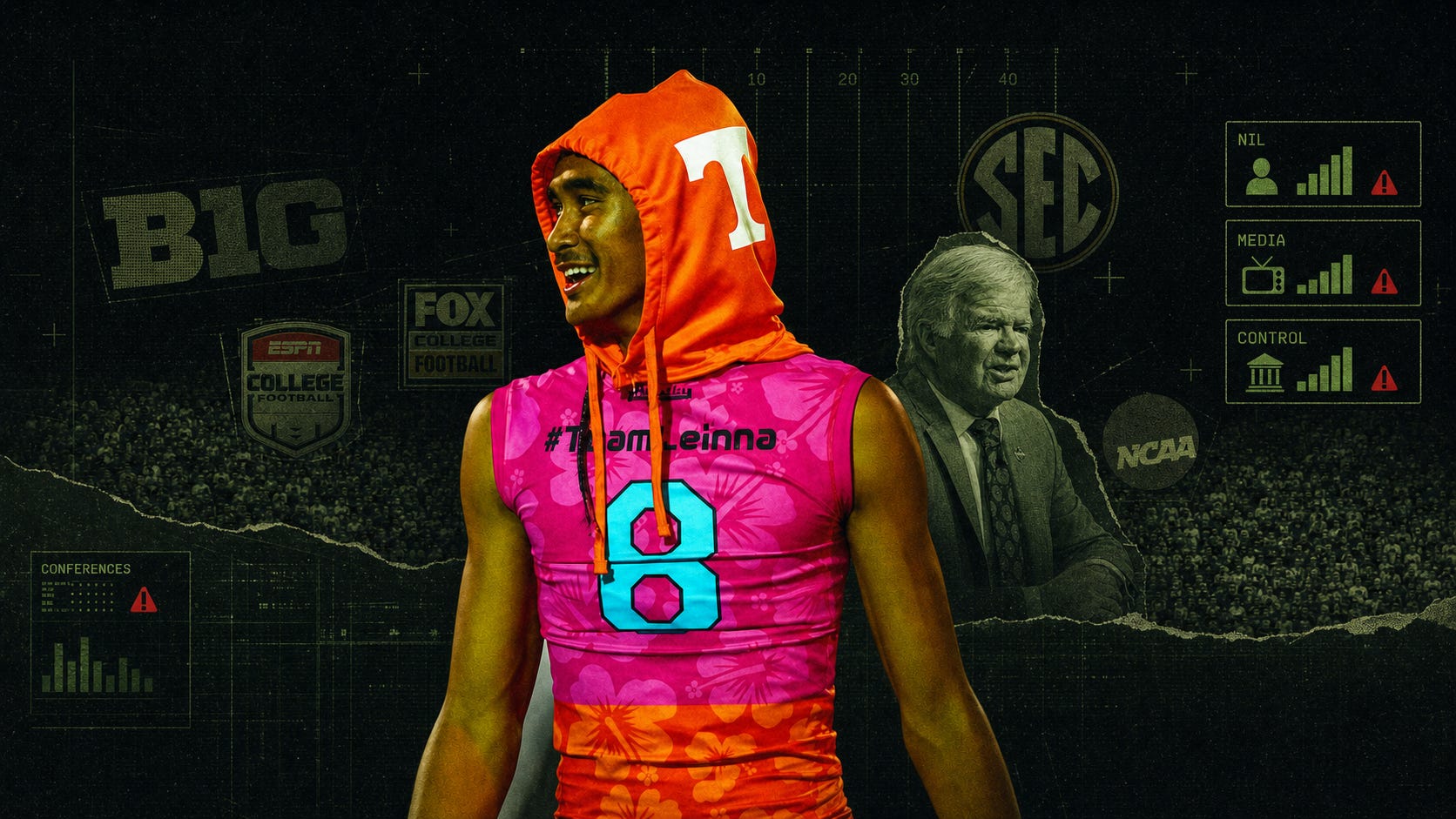
Quarterback Nico Iamaleava was not the first player to take the world by storm out of high school recruiting camps, but he may go down as one of the most important. Iamaleava was a consensus top five recruit in the 2023 class, rocketing up the rankings with a 6-foot-6 frame and an arm that snapped like a whip. Clips of Nico, clad in pajama pants and a beanie cap, making all types of insane throws were impossible to miss on social media. Timing is everything in life, and the Polynesian recruit had the luck or misfortune to be a high-profile quarterback recruit at the dawn of the NIL era. Committing to the famous University of Tennessee Volunteers, Iamaleava reportedly signed a four-year NIL agreement worth up to $8 million with Spyre Sports Group, a Tennessee-aligned collective, shortly before committing to the Volunteers, an earth-shattering number for a high school kid. Although NIL had been in place a few years prior, this represented the first instance where a major program flexed its financial muscles on an elite quarterback prospect in this new era where paying players explicitly was legal.
Iamaleava spent two years in Knoxville, leading the Volunteers to a berth in the first 12-team College Football Playoff. After the Vols lost to Ohio State in the first round, reportedly unhappy with Tennessee’s efforts to improve the team around him, and feeling like his $2m/year compensation was now below market for starting quarterback, Iamaleava’s camp (his father, a personal California based coach, one lawyer but no certified agent) reportedly contacted other programs to gauge their interest. The Volunteers coaching staff was notified by Oregon that the quarterback’s representatives were making overtures to test the market, while he remained a member of and the starting quarterback of an SEC playoff team. The situation reached a point of no return, and Iamaleava left Tennessee in the spring of 2025, eventually agreeing to a deal with UCLA for reportedly less than or equal to what he was making at Tennessee (all of this is not publicly available so it is impossible to verify).
Regardless of the financial piece, Iamaleava heading into his third year, chose to leave a program where he was the starting quarterback of a playoff team in one of the most storied programs in the country. Iamaleava ended up at UCLA, one of the worst teams in the country. The Volunteers, fresh off a playoff appearance, found themselves in quarterback turmoil well into the offseason. Given the initial claims that Iamaleava’s camp was dissatisfied with the Vols’ efforts to improve the team around him, for him to go to one of the weakest teams in the sport, despite later claims familial proximity drove the move, is a curious decision. Nico’s third season ended with 13 touchdowns and 7 interceptions and the team finished with a 3-9 record. For a player who topped recruiting rankings, was a consensus top prospect, Iamaleava has fallen into day three range on some early 2027 draft boards. His story is not over, but as of now it’s hard to argue that despite the financial windfall, Nico is better off.
Iamaleava’s journey so far is just one of many examples over the last few years that show the changing landscape of college football. In 2024 after winning the Sun Belt Conference championship, Marshall had to withdraw from its postseason bowl game after twenty-five players entered the transfer portal after their coach was hired by Southern Mississippi. In preparing for their first playoff game in the new era of the expanded playoff, Penn State found itself without its backup quarterback as the player was forced into entering the portal because of the aggressive market for transfer quarterbacks. A high school recruit flipped from Miami to the University of Florida, yet he never played a down for the Gators and a protracted legal dispute over a $14 million agreement was confidentially settled in 2026, while the original coach was fired and the recruit is on his fourth team in four years.
Five years into a new era, player compensation and movement, conference realignment, and record-setting media rights deals have transformed the sport. Without proper guidance and leadership, college football risks collapsing under its own weight as athletes, universities, conferences, and decision-makers rush to protect their short-term interests.
Continuing to list everything wrong with the current landscape without proposing solutions is a waste of everyone’s time. What follows is my attempt to save college football.
An Open Letter to the Powers That Be of College Football
To the NCAA, Conference Commissioners, University Presidents, Athletic Directors, and other decision-makers and stakeholders for the current state of the sport of college football:
What follows is an open letter where I hope to establish a discussion around a sustainable path forward for the sport that remains one of the most unique and beloved across America. With the fifth anniversary of Name, Image, and Likeness going into effect upon us, a reconciliation with the sweeping changes that have overtaken the sport—and consideration of what it has become and where we seem to be headed—is needed. I, just one simple fan, am among the many concerned with the direction the sport seems to be headed in.
While many will blame the transfer portal or NIL for the current issues, the ability of players to earn income and proper compensation for the value generated for programs and universities, as well as the freedom to “transfer” and change situations and the ability to realize market value, were logical and necessary changes.
The failure, for which decision-makers across the sport bear responsibility, was not preparing for an outcome in which athlete compensation and freedom of movement came to reality. At least a plan for things like clear and enforceable contracts, collective bargaining and certified representation for players should have been prepared. Things like a clear and coherent calendar for recruiting and transfers, and an organized, unified body governing the sport and enforcing these guardrails were your responsibility.
While the players have gained far greater rights in regard to compensation and movement, it has led to an erosion of the stability of the sport. Conferences, deciding to focus on maximizing revenue and controlling media distribution, blew up the regionality of the sport to form super conferences to squeeze more millions from television networks and media conglomerates.
For so long, you fought to preserve “amateurism” that when the courts began dismantling your compensation restrictions, and state laws forced the NIL issues, you threw your hands up in metaphorical exasperation and now skirt any sense of duty to the students and athletes you claim to serve.
Anyone who can spell “college” knows that athletes can now be paid, and players can transfer almost yearly.
I know you, the decision-makers, with the power to make changes, have remained adamant that the courts have limited your ability to govern and enact proper regulation.
I believe that though the sport of college football looks incredibly different now and unintended consequences have morphed NCAA Football into a David Cronenbergian body horror of a pseudo-professional sports league, something can still be done. We cannot retroactively go back and change the past, but we can take the lessons learned half a decade into this new era and chart a better path forward.
We can still save the game that is a part of people’s lives from birth. Fight songs, chants, and colors are as much a part of their genealogy as hair and eye color. Crisp fall Saturday mornings, tailgate lots filling around stadiums, generations young and old coming together to share something that bridges generational gaps. Sports, at their best, bring us together. They create shared moments and identity and allow us to be a part of something bigger than ourselves. No sport creates that more than college football in America. Much like with the broader country, we—and you, the ones with the power to do it—need to take dramatic action before it collapses under the failure of inaction.
The sport means too much to too many people to let unfettered greed, complacency, and apathy stop us from fighting for it.
Fight for the fan who was born into a generational rivalry, the family who spends all year thinking about the one day out of three hundred and sixty-five where they get the chance to knock their cross-state team off their perch.
What follows are the points I would encourage you to consider to stabilize the sport of college football.
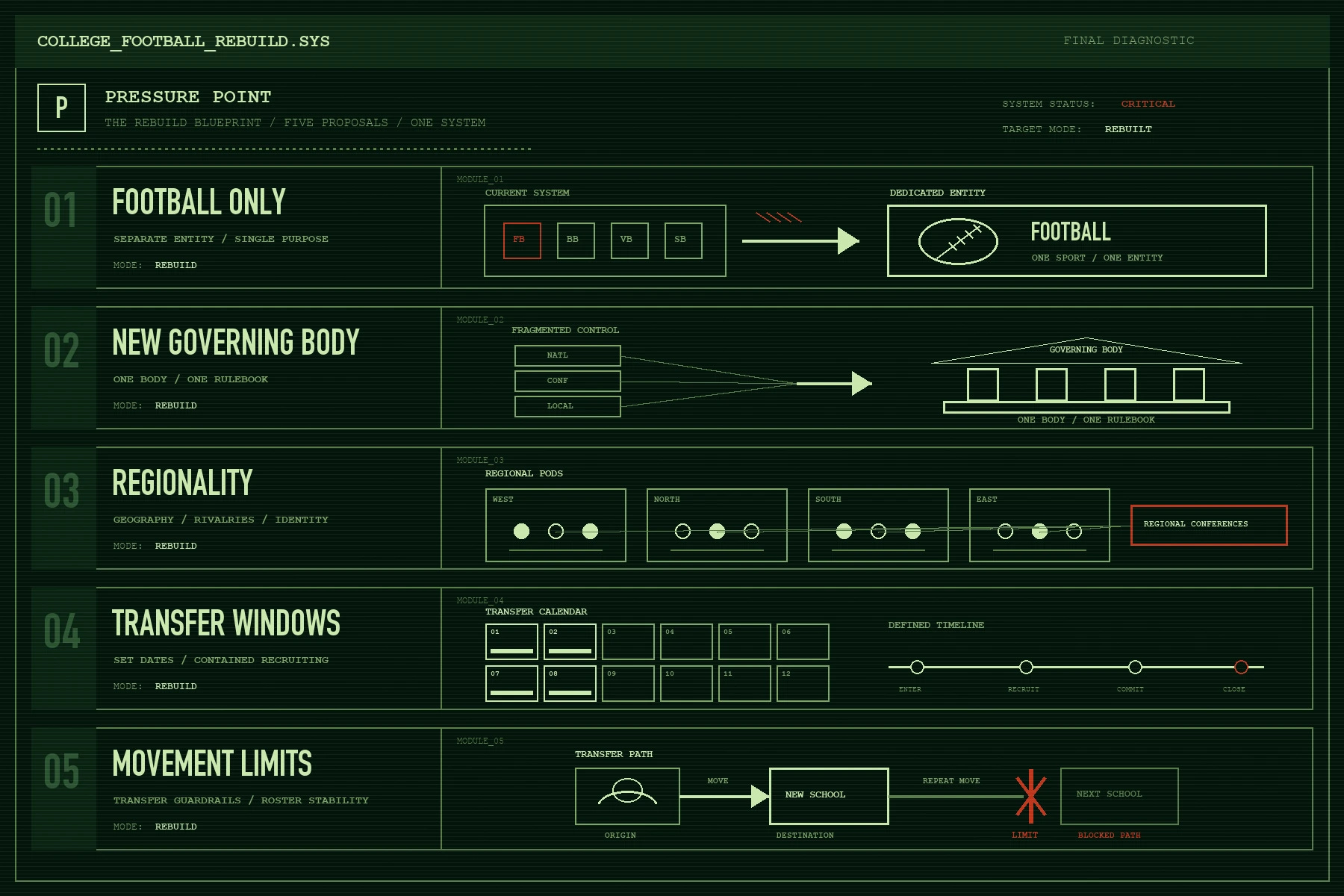
Football Carveout
College football has gotten so large and drives so much revenue, it is almost impossible to convince yourself it remains an amateur sport. The guise of “amateurism” grows more laughable by the year as more and more details become public about NIL valuations and television contract details. Football and basketball require so many resources and attention now from these athletic departments and universities, it has taken away from every other sport. The nationalization of football and expansion of conferences made business sense, but now the athletes competing in track and field or rugby have to figure out cross-country travel and reduced budgets as the football behemoth continues to grow.
A football-specific carveout from the NCAA should be established, allowing universities to remain a part of the NCAA for other sports, while football exists as a standalone entity.
This allows for the centralization of a governing body (more to come) that controls scheduling, competition, media, player movement, enforcement of rules and regulations, and the postseason.
Universities would retain ownership in the venture through their conferences, while a national players’ union sets up a Trust for players to earn an economic stake. Outside investors own minority stakes with non-controlling interests, and the NCAA owns a non-controlling economic position to fund the other sports that football had previously helped support.
Players are now able to be classified as employees, providing them with salaries, structure, and benefits and, most importantly, allowing for collective bargaining, which makes the transition to the NFL model—and its clarity around contracts, negotiations, and other problems—easier.
Transparent contracts, clear market information, public financial information about programs and schools also follow, creating a more sustainable path forward for the players, teams, universities, and sport overall. Hundreds of thousands of other student-athletes are now able to truly be the focus of an amateur athletic department and are no longer forced to operate under the shadow of the semi-professional league. The sport of football and its athletes, coaches, and staff finally get the full focus and operational expertise of one centralized entity focused on the growth of its own sport and ecosystem.
Establish a New Governing Body
A new governing body (president, commissioner, board) is elected and established, and leadership changes on an ongoing basis.
Once the legislation was established in favor of the players regarding name, image, and likeness as well as player movement - it almost seemed as if the NCAA and you decision-makers, having been publicly humiliated, decided that you were going to pout like you did when you disappointed your dad in middle school.
You guys wanted all this. Congrats. You deal with the problems.
The burden of legislation and determining how the new era of collegiate sports fell to conferences and universities, who immediately prioritized revenue and maximizing short-term financial windfall without the overbearing NCAA enforcing what they could do. A lack of accountability led all groups to act in short-term self-interest and self-preservation over the health of the whole. Conferences collapsed because of backroom deals led by power brokers, as television revenue became more important than the sanctity of competition.
Decisions regarding everything from NIL, player movement, compensation, rules and regulations, realignment, and negotiations of media rights are made by this group, and membership is elected and voted on by universities and the players. This new governing body also establishes a more formal postseason competition process that does not boil down to twelve angry men sitting in a room lobbying on behalf of their own personal conferences or schools so they receive a bonus payout.
Imagine if the NFL owners and Goodell got in a room every January to vote on who the playoff teams should be. Adam Silver of the NBA would have the New Orleans Pelicans playoff-bound yearly, one would have to assume.
Restore Regionality
What you, the people who have been running college football, have consistently failed to show you understand is that you have virtually eliminated what makes college football great and different from the NFL through dreaded “realignment.”
The sport of college football is special because, at its heart, it has always been a regional sport. It was built and expanded in places too small to have a professional sports team; the local university became the uniting force, becoming a symbol of that part of the country. For most of the U.S. for a period of time, the identities of the demographics of these regions were inextricable from the teams themselves. Roll Tide in humble and polite Alabama. Go Blue in blue-collar northeastern Michigan. Fight On in the glitz and glamor of Southern California. Winning championships was and remains the goal, but beating your rival is more important.
This sport is special because team rivalries and animosity transcend generations and only grow deeper with time. Realignment has pushed cultural touchstones such as Washington-Washington State and Oregon-Oregon State out of their traditional conference foregrounds, while the iconic Notre Dame-USC game is entering an indefinite hiatus. Florida vs. Georgia or Texas and Oklahoma remain too big a part of the media rights deal to touch, but these rivalries are no less important. Talk to anyone who participated in an Apple Cup about how much that game meant. As someone who grew up in the middle of the Pitt–WVU rivalry, I can tell you that though those schools rarely competed for championships, the game itself every year was its own Super Bowl, fueling the fan base and programs on a yearly basis. Ask anyone in Western Pennsylvania or West Virginia what significance 13-9 has, and they’ll tell you.
The new entity would reestablish the major geographic/regional conferences: Big Ten, SEC, ACC, Pac-12, and the Big 12.
Your representatives and officials promote pageantry, yet they killed what actually built the tradition and rivalries that were the backbone of the sport by allowing regional conferences to fall apart as bigger brands like Texas, Oklahoma, Washington, and Oregon defected from their regional conferences for more money in the SEC and Big Ten, respectively.
Every game matters, but nothing so much as that one shot a year you have against the team you hate most. For 364 days out of the year, you will have to either soak in the glory of victory or eat crow in defeat. It’s your annoying cousin who went against the family and went to Tech instead of State.
It is hard to create the regional intensity and history when half your games every year are against teams in a different time zone. The Pac-12 is gone; so is the Big East. The ACC remains on life support. The Big 12 has gone as far as to sell regular season naming rights to an energy drink company.
The new league, now in a position to negotiate its media deals across the entire sport, is able to effectively revenue-share and balance out the discrepancy. The existing media rights are paid out pro rata to universities that are a part of the original agreements, and going forward the new entity negotiates the value of its media deals on a league-wide basis and each school earns an equal portion of the media rights. This likely upsets certain programs and universities in the short term, but in the long term the value of the league and sport makes up the difference.
The regional heart starts beating again, and the sport is better for it.
Establish Clear Transfer and Recruiting Timelines
The calendar for roster changes is a major issue. Before the season is over, teams’ players are either being poached by rival teams to enter the portal or renegotiating their own deals; the high school recruiting roller coaster is in full swing; and there are still postseason games to prepare for.
Immediately set transfer and recruiting windows where contact is permitted with transfer-eligible players only after they have officially entered the portal.
High school recruiting periods are offset from those windows.
Most importantly, any breach of these terms is strictly enforced (something the NCAA and your entities have made a laughable effort at doing consistently). Failure to adhere to these rules and regulations would result in severe financial and recruiting penalties, and possible postseason bans.
A constant cycle of never-ending player movement destabilizes programs and the sport at large. While the NFL is a cold and calculating business, college football players form a special relationship with their programs and their fan bases, as they literally grow with them. Saquon Barkley showed up in Happy Valley as a four-star recruit out of eastern Pennsylvania, and left as one of the biggest stars in the sport. I am not sure that, if the current environment had existed then, he would have been able to stay, because an SEC program, Oregon, or Ohio State would have come calling before his sophomore season had even finished.
Transfer Limits
In addition to clear windows and operating procedures regarding recruiting, the current dynamic of yearly and unlimited transfers has hurt the sport.
All athletes are granted one transfer to use per four years of eligibility. A second transfer shall be granted: a) if the head coach to whom they committed is fired or leaves for another job or b) upon receiving an undergraduate degree.
The previous transfer limitations were authoritarian and widely anti-player, but a total 180 has created different problems. While I support a player’s ability to change situations and realize their market value, constant labor shifting and renegotiation of contract values on a yearly basis has destabilized the sport, weighed on programs, and alienated fans.
There is a reason that, with collective bargaining and players’ unions, contract negotiations happen in a more streamlined fashion and during the offseason, with occasional overlap into the start of the season. Players deciding in the middle of the season to sit out, transfer, or renegotiate rarely if ever happens for these reasons.
For programs, it makes planning for the long term a nearly impossible feat, and while I credit the Hoosiers of the world for being able to effectively build championship rosters overnight, a world of unlimited and unpredictable transfers will fundamentally continue to erode the sport. If we cannot find a middle ground where players have the ability to realize their market value while also committing to programs for longer than a year, how can we have a stable ecosystem?
A lot of college football coaches will preach the line “transformational, not transactional,” and while they are using it as sales propaganda—the ethos is correct. The sport, at its best, has allowed millions of young men not only to change their families’ lives financially but also to form and develop a brotherhood they can be a part of for the rest of their lives. A world where market forces force them to become mercenaries on a yearly basis, falling victim to unbridled capitalism before they can legally purchase a beer, has wider implications than just what logo is on their helmet.
I think the proposal above is a reasonable compromise that benefits the stability of the sport, creates a more predictable and steady labor environment, increases the fiscal and media value of the sport, and still allows players the ability to change their situation or test their market value.
Conclusion
I acknowledge these are aggressive and optimistic proposals, but I also believe the roadmap for what is possible looks not that dissimilar from the suggestions I have made here. The NCAA, conferences, universities and other power brokers in the sport have told us it is impossible. However, when the sport inevitably collapses, they will try to say they told us so.
It is a starting point from which to reclaim organization and guardrails for the sport that I—and we, if you made it this far—love. That’s the difference, and what is missing with the people running the sport and conferences now. Their indifference and lack of proactive thinking make it hard to imagine that they love the sport we grew up on: fall Saturdays spent grilling outside before heading into a modern colosseum to watch the gladiators of our childhood do battle. They have probably never sat in the bleacher seats, only private suites.
I am willing to admit college football is flawed, but I still love it and still believe it can be saved.
This is not meant as a diatribe arguing, “Well, if everything went back to the way it was when I was a kid, it would be better.”
The world has changed; players should be paid and able to transfer. For too long, labor was exploited to the benefit of universities and power brokers, and kids they made millions from were left with nothing.
I am glad it has changed. I am glad programs like Indiana, even though I have given them grief, can be a realistic contender. The old system had too few haves and too many have-nots with no realistic path to contention or long-term sustainability.
Players should be able to make as much money as they can from their likenesses and talents, but there needs to be clarity, transparency, structure, and clear rules and regulations—and consequences for breaking them. Compensation around likeness and personal brand should not be cover for explicit pay-to-play without any clear transparency, structure, or protection on both sides.
College football is not dead. I am not even sure it is dying.
It is making more money and being watched more than ever.
But I am reasonably confident that on this current trajectory, if stakeholders do not step in and enact proactive changes, the sport is going to self-destruct.
Slowly, then all at once, as all great empires fall.
I hope I’m wrong.
— Sincerely, an obsessive and loving College Football Fan
Super well thought out article, Dante.
I couldn’t agree with your recommendations any more. I’ve been a die hard Tennessee fan my entire life and I’m being pushed to the fringes of becoming a “casual” fan because of the current environment.
I followed the twists and turns of the Nico story as it all went down. A few years later, it’s hard for me to not feel bad for him because he was clearly following guidance from dumb people (ex: his dad).
While I believe there is still time to fix this mess and implement your recommendations, I also worry that we are running out of time.
Nothing beats a college football Saturday for me, I just hope I’m still saying that in 10 and 20 years!